How to Play Flowers and Deities
The combat loop: deploy, bleed, spend, and break morale.
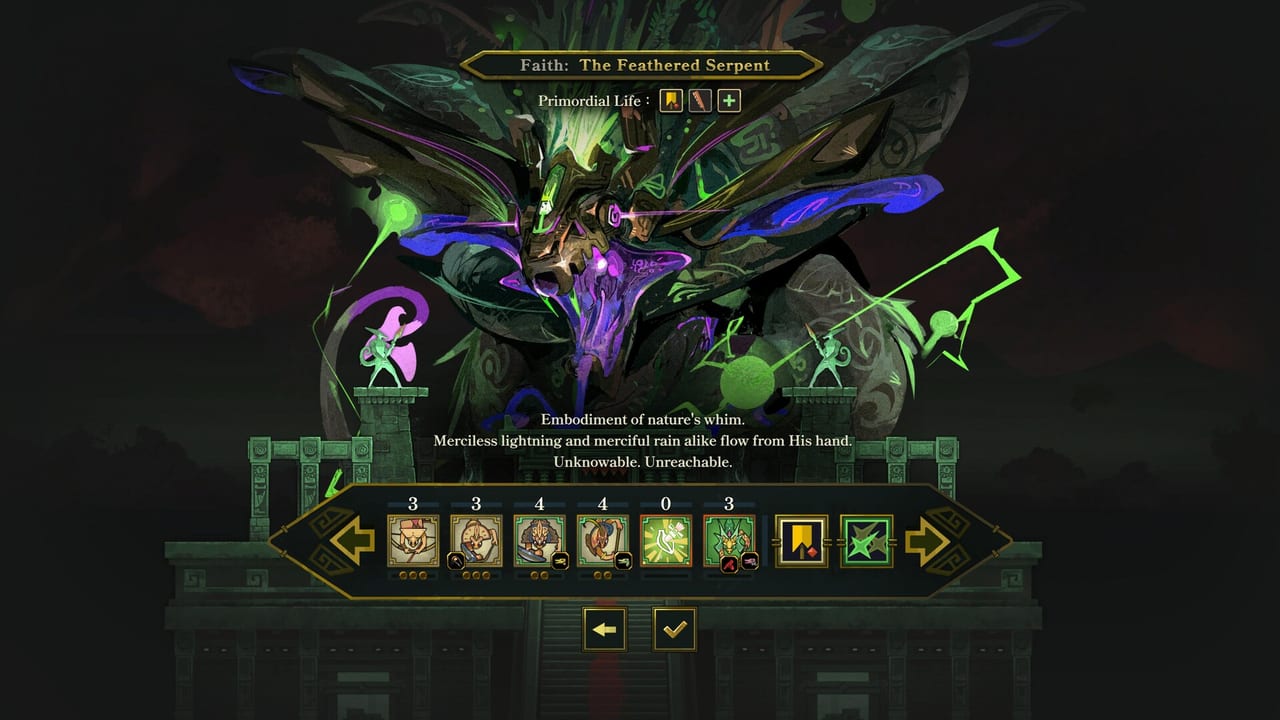
Flowers and Deities plays like an autobattler with a commander still on the field. You do not steer every lizard. You decide who is allowed to exist, where the first rank stands, and which god-spell fires when the blood is deep enough. If you treat it like a pure idle sim, mobile enemies and backline snipers will walk through you. If you treat it like a clicker, you will dump Favor on the wrong stack and watch morale collapse.
This page is the rules of a deathmatch. Getting Started covers the city. How Blood Works covers the resource that makes the spells legal.
The skill bar is your deck
Steam calls the game a strategy deckbuilder. In practice the “deck” is the active party: a short list of unit stacks and spells you bring into the arena. Each stack has a Favor cost and a circle count that shows how many copies you may drop. A four-cost blade wielder that you can drop twice is a different card from a one-cost rain spell you can fire every time the cooldown returns.
You swap the active party in the city. Reserve units still exist; they just do not appear on the bar. A common first-run mistake is leaving a newly bought veteran in reserve while an obsolete slinger still occupies a bar slot. Before you gate, open Replace Army and ask whether every icon earns its Favor.
Spells sit on the same bar. Faith often grants a signature summon or a heal. Items can add more. You will not cast all of them every round. You will cast the one that answers the enemy formation: a dodge aura into javelins, a heal into a charge, a summon into a hole on the flank.
Deploy order and the center line
When the arena loads you see two armies and a center line you cannot cross during setup. Click your units in the order they should hit the sand. Frontliners first if you need a wall. Chargers second if you want them to crash after the wall exists. Ranged last so they inherit a pocket instead of spawning in the enemy’s face.
Favor is the budget. Early rounds sit near 16 and climb as the series continues; later rounds in a recorded run reached 19 and 21. You do not have to spend the entire bar. Unused Favor is wasted potential, but an extra four-cost stack that overlaps your own charge lane is also wasted. Fill the cap with a cheap darter if the last four points cannot buy another elite.
Right-click any unit, including the enemy preview, to read Reach, morale, and traits. Reach was reworked during Next Fest so weapon length maps to attack range. A spear in the second rank is a plan. A club in the second rank is a tourist.
During the fight: spells, blood, and morale
After you commit, columns walk. You still click. Blood puddles form where bodies fall. Many spells drink that pool. If you wait for a “perfect” moment, the puddle may sit under the wrong rank and your summon will path like a drunk beetle. Click sooner than you think, then use speed-up only after the first volley makes sense.
Morale is the hidden win condition. Armies that lose the front and fail a check start to flee. Encouragement skills, healing that also raises morale, and sudden summons that look like reinforcements all matter more than a 2% damage charm. Steam’s Next Fest notes added morale modifiers on purpose because support spells felt like flavor. They are not flavor anymore.
Stun, poison, burn, and wounds are status traffic. 1.0 raised the poison cap from 5 to 8 and buffed weapon enchantments. Magic damage remains the community scare: thunder priests can delete a boss if you have no resist plan. Bring a disrupt or a sacrificial front if the preview shows a glowing caste.
Best of three, then loot
A node is usually a short series. Win two rounds and you loot. Lose two and you spend a campaign life; the launch build is more forgiving on medium difficulties because enemy gear budgets shrink after a defeat. Do not reroll your entire bar after one ugly round. Change the deploy order first. If javelins shredded you, put dodge or shields in front and keep the same units.
Loot is a short draft: weapons, ornaments, sometimes a blessing. Take the piece that feeds the origin, not the highest rarity on a slot you do not own. The Forge can raise quality later. A heroic axe on a unit without a weapon slot is a paperweight until you pay for the slot.
City events fire between nodes. Some are free gold. Some are ritual risks. The Next Fest demo unlocked about 100 events; 1.0 keeps that layer. Read the text. “Kill allies in the ritual area, gain Favor” is a real button, not flavor, and it will grief a thin roster.
Watch a real run, then copy the habits
The video in the middle of this page is a public demo run, not a scripted trailer. Watch how the commander forges before recruiting, how blade wielders eat the first Favor, and how a lost round becomes a formation note instead of a reset. The full release adds more units and unlocked archetypes, but the click order did not become a different genre.
When you can win a series without staring at the Favor number, graduate to How to Beat the Campaign and the Units Tier List. If the problem is “my summon walks into the clubs,” open Positioning and Summons next.
Frequently Asked Questions
Quick answers drawn from the current Steam build.
Is Flowers and Deities an autobattler or a deckbuilder?
Both labels are fair. Combat resolves automatically after you deploy, but the active party of units and spells is a deck you edit in the city and spend Favor to play.
What happens if I lose one arena round?
Most nodes are best of three. One loss is information. Two losses cost campaign pressure, though 1.0 softens enemy gear after defeats on lower and medium difficulties.
Do I need to spend all of my Favor?
Spend enough to field a complete line. Dumping leftover Favor into a unit that blocks your own charge is worse than holding two points.
Where do I read unit stats?
Right-click the unit in the city or the arena preview. The in-game encyclopedia also lives in Settings.